
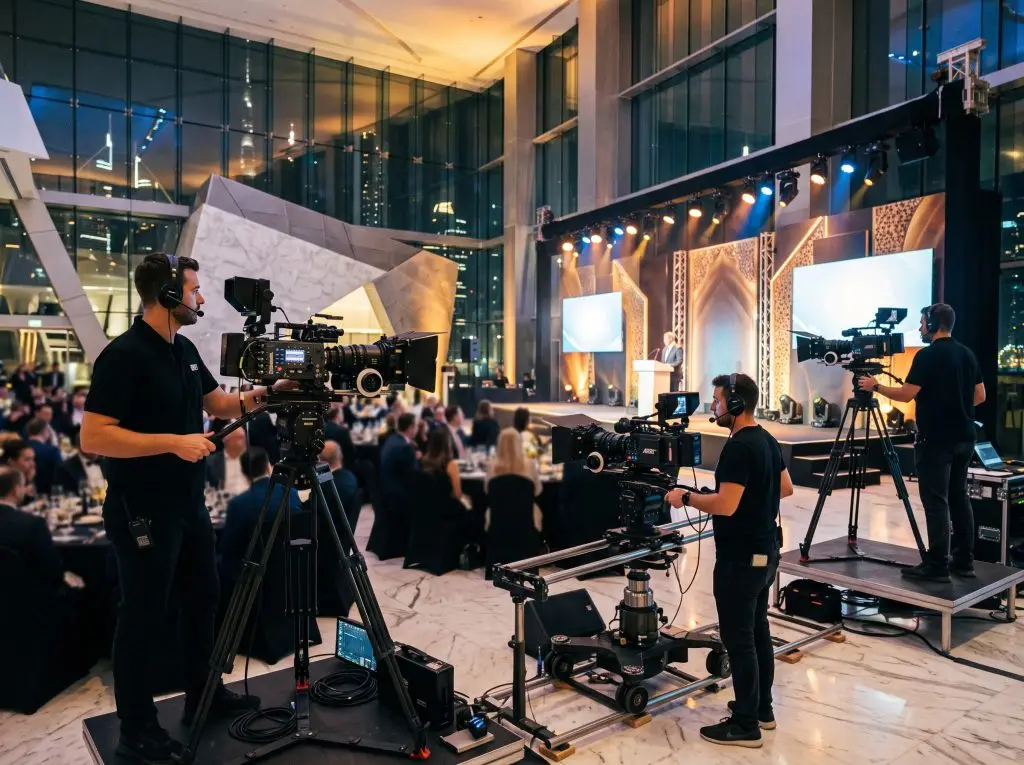
Events across the UAE have grown far beyond a single stage and a single storyline. A corporate summit in Dubai might run keynote speeches, panels, and networking sessions at once. A wedding in Abu Dhabi might have a groom’s entrance on one side of the venue while the bride’s procession begins on the other. When so much happens at once, one lens can’t keep up. This is exactly why multi-camera video recording has become the standard for events that want their footage to reflect the full experience, not just fragments of it.
Producers who plan multi-angle event coverage from the outset can map out every stage, entrance, and reaction before the event even begins, rather than trying to fix gaps afterward.
Table of Contents
ToggleThe Growing Scale of Events Across the UAE
The UAE’s event calendar is one of the busiest in the region, with conferences, product launches, award nights, and large weddings happening almost every week. Venues have grown taller, wider, and more elaborate, often spanning multiple rooms or outdoor extensions within a single program. As an event’s footprint grows, so does the risk of missing something. A single operator can only face one direction at a time, a limitation that shows the moment an event has more than one focal point, which is now the norm.
What Single-Camera Coverage Misses
A single camera forces a videographer into constant trade-offs. Stay on the stage for the speaker’s expression, or pan to the audience for the reaction? Follow the couple during a first dance, or hold a wide shot of the room? Every choice made with one camera is a choice against something else, often leaving footage that feels flat, with abrupt manual pans and gaps where the story had nowhere else to be seen. These are moments guests remember vividly but that never made the final edit.
How Multi-Angle Filming Captures the Full Story
Multi-angle filming solves this by placing several cameras around a venue at once: a wide establishing shot, a tighter shot on the main subject, and side or rear angles that catch details a front-facing lens would miss. Instead of choosing between the stage and the crowd, both are filmed simultaneously. This also protects against the unpredictability of live events. If a speaker goes off script or a first kiss happens earlier than planned, there’s no single “right moment” to worry about missing, because every angle is already rolling.
Filming from several angles is only half the job; the footage still needs assembling into something coherent. This is where live camera switching comes in, a technique borrowed from television broadcasting. An operator watches every feed in real time and cuts between them the moment it makes sense: a wide shot to a close-up during an emotional toast, or a reaction shot the instant applause breaks out. Done well, this removes the need for lengthy editing later, because the story is effectively directed live, angle by angle. For events that also stream online, our hybrid event switching guide breaks down how this works in practice.
Events That Benefit Most From Multiple Camera Angles
Some UAE events lean on multiple angles more than others. Conferences and product launches often run parallel content that one crew member can’t cover alone. Weddings move between separate ceremony and reception spaces, and concerts involve crowds and performers spread across a wide area, where audience energy is as much a part of the story as what happens on stage. We’ve covered this in more depth in our guide on multi-camera corporate event setups.
For outdoor events, ground-level cameras can only show so much of a venue, which is why many large-scale UAE programs now bring in an aerial perspective too. A wide shot from above can reveal the true size of a desert wedding setup or a festival crowd in a way no ground camera could. Aerial drone videography is usually reserved for opening and closing sequences, giving the edit a sense of scale before it settles back into the ground-level story.
Pairing Multi-Camera Recording With Live Streaming
Many organizations in the UAE now want their events to reach people who can’t attend in person, whether that’s a shareholder abroad or a family member who couldn’t travel. Multi-camera recording pairs naturally with live streaming coverage, since the same camera feeds used for the recorded highlight video can also be pushed out live. Remote viewers get the same variety of angles as anyone in the room, rather than one static shot of the stage, and for hybrid events this pairing has quickly become the expected standard.
Adding Interactive Touches to Large-Scale Events
Beyond the recorded film itself, larger UAE events increasingly build in moments guests can take part in directly. Interactive video booth experiences near an entrance or lounge let attendees create their own short clips during breaks in the program. These don’t replace the main multi-camera coverage, but they give guests something tangible, and tend to lift the energy on the day.
Choosing the Right Production Partner in the UAE
Because so much of the value in multi-camera coverage comes down to planning, where each camera sits, how many operators are needed, how switching will be handled, the production partner matters as much as the equipment. Teams that specialize in event video production walk a venue in advance and map camera positions against the run of show. Planning ahead also pays off after the event: the same raw footage can be cut into a highlight reel, short social clips, and a sponsorship trailer, each pulling from whichever angle tells that story best. Our piece on repurposing event footage covers how to plan for that at the recording stage rather than forcing it out of single-angle coverage afterward.
Dubai Fotographer works across weddings, conferences, and large-scale UAE events with this kind of upfront planning, treating each program as a live production rather than a point-and-shoot job.
Final Thoughts
As UAE events continue to grow in scale and ambition, the gap between what a single camera can capture and what actually happens in the room keeps widening. Multi-camera recording closes that gap by treating an event the way a broadcast would: covering every angle, cutting between them intelligently, and preserving reactions that would otherwise be lost. For anyone planning an event that spans more than one stage, room, or moment worth remembering, it’s become less of a luxury and more of a basic expectation.
Frequently Asked Questions
1. How many cameras are typically used for a UAE event?
Most mid-to-large events use three to six cameras, depending on venue size and key moments.
2. Is multi-camera recording only for large events?
No, smaller events benefit too, whenever there’s more than one focal point, like a stage and a seated audience.
3. Does multi-camera coverage take longer to edit?
Usually the opposite, since live switching reduces the manual cutting needed afterward.
4. Can multi-camera footage be live streamed at the same time?
Yes, the same camera feeds used for recording can be routed into a live stream simultaneously.
5. What’s the difference between multi-camera recording and standard videography?
Standard videography relies on one operator making real-time choices; multi-camera recording captures several angles at once for a fuller result.