
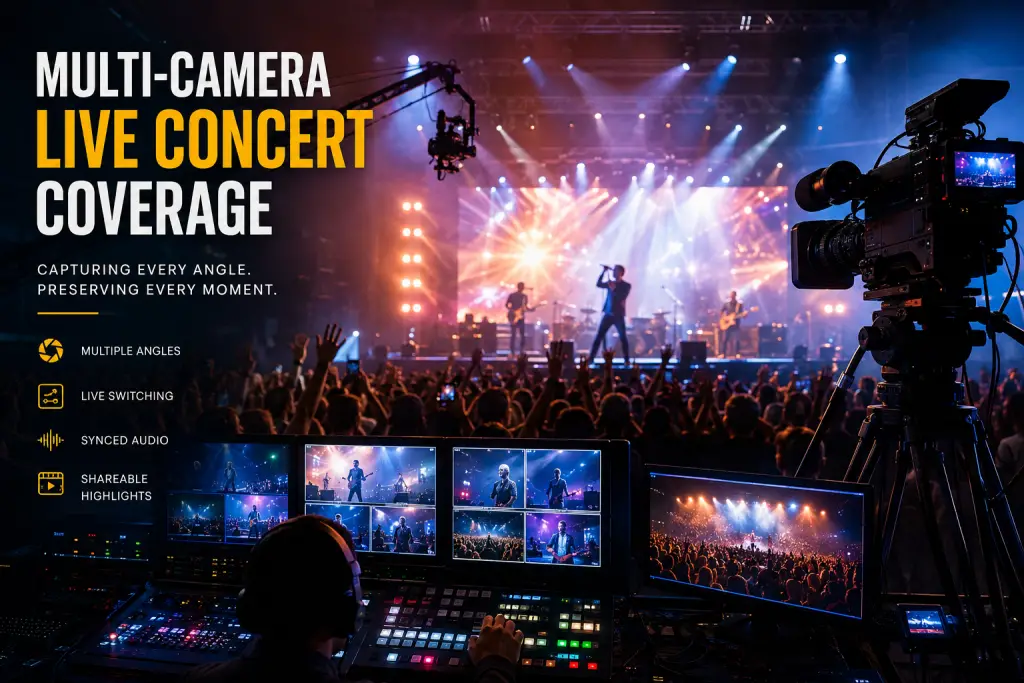
A live concert moves fast. The lead singer steps to the edge of the stage, a guitarist launches into a solo, and thousands of hands go up at once, all within the same few seconds. A single camera can only follow one of those moments at a time, which means the other two are gone forever. This is exactly why multi-camera filming has become the standard for live concert coverage in the UAE, where event organizers, venues, and artists want footage that reflects the full scale of the performance, not just fragments of it.
For anyone planning a concert, festival, or large-scale music event, understanding how multi-camera production works can make the difference between footage that feels flat and footage that feels like being there. Behind every successful concert recording is a carefully planned setup designed to keep pace with fast-moving performances and constantly changing stage action, ensuring every key moment is captured from the right angle at the right time.
Table of Contents
Why One Camera Can’t Capture a Live Concert
Concerts are not scripted the way a product shoot or a corporate presentation is. The energy shifts constantly, the performer moves across the entire stage, and the crowd reacts in ways that are impossible to predict in advance. A single fixed camera forces a videographer to choose between the performer, the band, or the audience, and whichever one is left out becomes a gap in the final story.
Multi-camera filming solves this by placing several cameras at different points around the venue at the same time. While one camera holds a wide shot of the full stage, another can zoom in on a musician’s hands, and a third can capture the crowd singing along. Nothing important gets missed simply because the footage wasn’t pointed the right way at the right second.
Framing the Full Performance: Wide Shots, Close-Ups, and Crowd Reactions
Good concert coverage is really a mix of three perspectives working together. Wide shots establish the scale of the event and the design of the stage. Close-ups bring the audience into the performer’s expressions and the details of the instruments. Crowd shots remind viewers that a concert is a shared experience, not just a performance happening on a screen.
Positioning is everything here. Cameras are often placed front-of-house, on the side of the stage, and occasionally on a raised platform or via aerial event videography to capture the full crowd from above. Each angle contributes a different layer to the story, and it’s the combination of all of them, not any single shot, that makes the final video feel complete.
Flawless Camera Switching for Broadcast-Quality Footage
Capturing multiple angles is only half the process. The real skill lies in switching between them at the right moments, either live during the show or in post-production editing. A camera switch that lands just as the chorus hits, or just as the crowd erupts, is what separates amateur footage from something that feels professionally produced.
This is particularly important for concerts that are being shared beyond the venue itself, whether through highlight reels, social media clips, or broadcast-quality live streaming for fans who couldn’t attend in person. Smooth, well-timed transitions between camera feeds keep viewers engaged and make the recording feel closer to a professional broadcast than a single phone recording from the crowd.
Syncing Multiple Feeds With Live Concert Sound
Visuals are only one part of concert coverage. The audio has to line up perfectly with whichever camera angle is on screen at any given moment, and with multiple cameras recording simultaneously, keeping everything in sync becomes a technical challenge on its own. Timecode syncing is typically used so that every camera feed can be matched precisely to the live sound feed during editing.
This matters more than it might seem. A slight delay between the sound of a drum hit and the visual of the drummer striking it is enough to make footage feel amateurish, even if the camera work itself was excellent. Getting the sync right is what allows editors to cut between angles freely without ever breaking the illusion that the viewer is watching one continuous, natural performance.
Working With Fast-Changing Stage Lighting
Concert lighting is designed for the audience in the room, not for cameras. Strobes, colored washes, and sudden blackouts are part of the visual language of a live show, but they can be difficult to film without losing detail or introducing flicker. Multi-camera setups need to account for this by using cameras and lenses capable of handling low light and rapid changes without the footage looking grainy or inconsistent between angles.
Because each camera may be catching a different intensity of light depending on where it’s positioned relative to the stage rig, color matching becomes an important step later in editing. The goal is for every angle to look like it belongs to the same performance, even though the lighting hitting each lens may have varied significantly throughout the set.
Turning Raw Footage Into Shareable Concert Highlights
Once a show wraps, the real value of multi-camera filming becomes clear. Instead of one long, single-angle recording, editors have a full library of angles to pull from, which makes it far easier to build short highlight clips, artist recap videos, or promotional teasers for future events. This flexibility is one of the biggest reasons artists and event organizers in the UAE are moving toward multi-camera coverage rather than relying on a single fixed recording.
The process of repurposing event footage for social media also becomes much simpler when multiple angles are available, since editors can cut vertical clips, highlight reels, and behind-the-scenes content from the same raw material without needing to reshoot anything.
Planning a Multi-Camera Shoot for Your Next UAE Concert
Multi-camera concert coverage works best when it’s planned before the first note is played, not improvised on the day of the show. Camera positions need to be scouted around the stage layout, lighting design, and expected crowd movement, and the number of cameras used usually depends on the size of the venue and how the footage will eventually be used. Teams like Dubai Fotographer approach this planning stage as closely with the venue and event organizers as with the performers themselves, since concert logistics can shift quickly and the camera plan needs to be able to adapt with them.
Final Thoughts
Live concerts are built on energy that exists for only a few hours and never happens in exactly the same way twice. Multi-camera filming is what allows that energy to be captured properly, giving viewers the wide shots, the close-ups, and the crowd reactions that together tell the full story of the night. For anyone organizing a concert in the UAE, understanding how this process works is a useful first step before choosing a production team for the next event.
Frequently Asked Questions
1. How many cameras are typically used for concert coverage?
It depends on venue size, but most concerts use between three and six cameras to cover the stage, performers, and crowd.
2. Does multi-camera filming require a bigger crew?
Yes, each camera generally needs its own operator, along with a technical director to manage switching and syncing.
3. Can multi-camera footage be used for live streaming as well as recording?
Yes, the same camera setup can feed both a live stream and a separate recording for later editing.
4. How long does editing multi-camera concert footage usually take?
Turnaround varies by concert length and final deliverables, but multi-angle editing typically takes longer than single-camera editing due to syncing and color matching.
5. Is multi-camera filming only useful for large concerts?
No, even smaller live music events benefit from multiple angles, since it gives more flexibility for highlight clips and social media content.
The same crew plan is used on the show floor. Read how multi-camera recording works for UAE exhibition stands.